Buying guide · 1990–1995 · M119 5.0 V8 · 320–326 PS
Mercedes 500 E W124
Everything that decides whether the one you are looking at is a good buy or an expensive one.
38-page guide, A4 and phone · 4-page inspection card · instant PDF · VAT included



In the guide
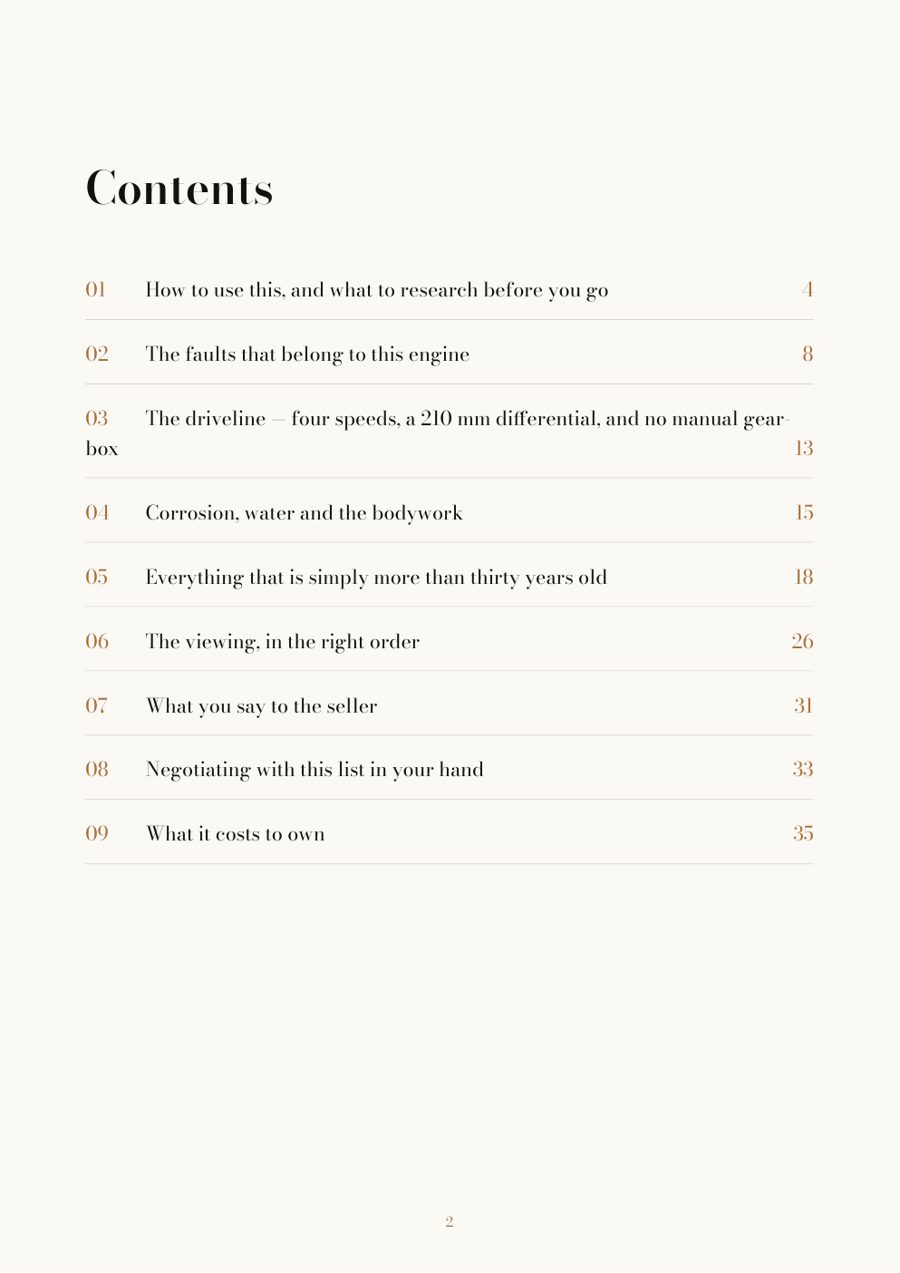
What the Mercedes 500 E W124 guide covers
- 01Every fault this engine has, and how much work it is
- 02How to tell a 500 E or E 500 from the E 60 AMG that shares its type number, and what the birth certificate from Mercedes-Benz Classic can and cannot settle
- 03Where these cars rust, from the 2017 buying guide and auto motor und sport — including the rear axle mountings, the one job in this guide that is a week or more
- 04What is simply more than thirty years old — and can be left alone
- 05The inspection card: the whole viewing on paper, in order, to take with you
- 06What to say to the seller, and what to keep to yourself
From the guide itself
This is how it reads
This is what one of the fifteen looks likeLast Real Engines
5 · The self-levelling rear suspension
An hour or two for the spheres · Expensive part, easy access
Every 500 E and E 500 has it. Mercedes' archive gives the rear suspension as "multilink suspension with hydropneumatic level control" for both, and as "hydropneumatic level control optional" on the 400 E and E 420. The product information explains why it is standard: "um unter allen Betriebsbedingungen ein konstantes Fahrzeugniveau zu gewährleisten" — to keep the car at a constant level under all operating conditions. The same document says the adaptive damping system ADS "ist für den 500 E nicht vorgesehen" — was not offered on the 500 E.
How the W124's system works, in Practical Classics' description of the range: a pressurising pump under the bonnet, and "unlike the traditional Citroën application, the Mercedes system had a fixed ride height and employed rear coil springs to maintain the static ride height when parked." What fails, according to the 2017 buying guide: "Front springs and self-levelling rear suspension spheres can fail – check it sits level, especially when loaded." AUTO BILD counts "die hydropneumatische Niveauregulierung an der Hinterachse" among the 500 E-specific parts that make a repair expensive. No source we could open says how many years a set of spheres lasts.
Two things follow for a viewing, by our reading of Practical Classics' description. The pump sits under the bonnet, so a load in the boot is judged after the drive, with the engine running — not while the car stands with the engine off. And when the car is parked, its coil springs hold the height, so a rear that sits low after standing is a question for the springs, item 7, as much as for the level control.
Leave it when the rear sits level after the car has stood, and is level again after the drive with a load in the boot. Now, as a diagnosis, if it sits low: the springs and the level control both, before anybody prices spheres.
And this is how the card readsLast Real Engines
- 1 · Round the outside, before anybody starts it
- 2 · The boot and the cabin
- 3 · Under the bonnet, cold · engine off, key out
- 4 · The cold start · the seller starts it; nobody revs it
- 5 · The drive · gently until it is fully warm
- 6 · The warm engine · idling, hands clear
Start with the free guide
The six questions that decide whether this car is a good buy
- Is it a 500 E — and is it the car its papers say?
- The timing chain's guide rails — has anybody replaced them?
- The engine wiring harness — is the insulation still whole?
- Rust — on a W124 body with its own wings?
- The parts only this model has — front axle, brakes, self-levelling?
- How far has it really gone — and does the history show it?
Start with the free guide: what this car is, and the questions that decide whether the one you are looking at is a good buy or an expensive one.
Before you buy
Questions
What exactly do I get?
The full guide as a PDF, 38 pages in A4, plus a phone edition to read at the car; and the inspection card, 4 pages to print and take to the viewing. €24, VAT included.
How is it delivered?
Straight after payment you get a download link for the guide, the phone edition and the card. No subscription, no account.
Can I get a refund?
EU consumer law gives you fourteen days to change your mind. For digital content that right ends the moment delivery starts, provided you agreed to that at the checkout. If the file will not open, or you were sent the wrong car, write to us and we will fix it or refund it.
Who handles the payment?
Lemon Squeezy, who sell the guide to you as merchant of record. They charge the VAT at the rate of your country, send the invoice, and email you the download link. We never see your card.
Why are there no prices in it?
Because a price we cannot verify is worse than no price, and because a price would be wrong for most of the people reading it: workshop rates across Europe differ by a factor of two or three. What does not change is how much work a job is, so every point says whether it is an hour, half a day, a day, or a week in the workshop. Ask your own workshop for its hourly rate, and every hour in the guide becomes your own number.
Is this advice about a specific car?
No. A guide tells you what to look at; it is general information about the model and not advice about a specific car. Have every car inspected before you buy by someone who knows the engine.
More Mercedes-Benz guides


